
• Passa alla navigazione primaria
  • Passa al contenuto principale
  • Facebook
  • Instagram

info@zenon.it | tel. 3492462987

  • Home
  • Corsi
    • Tutti i corsi e gli orari
    • Yoga
      • Yoga (lezioni collettive)
      • Yoga: lezioni e percorsi individuali (a Novara e online)
      • Respirazione – Pranayama
      • Yoga: cose da sapere (FAQ)
    • Meditazione
    • Yoga in gravidanza
    • Attività post parto
    • Qi Gong e Taijiquan
    • Functional Training
    • Ginnastica funzionale adattata
  • Eventi
  • Chi siamo
  • Blog
    • Yoga
    • Yoga in gravidanza
    • Meditazione
    • Qi gong
    • Pratiche
    • Taoismo
    • Interviste
  • Contatti

Zénon

Yoga: Respiro: Prāṇāyāma

18 Ottobre 2018 by Zénon

Nelle ‘normali’ lezioni di yoga, le tecniche di respirazione e di Prāṇāyāma godono spesso di uno spazio molto ridotto rispetto alla pratica posturale.

Tuttavia, la particolare amalgama col respiro è ciò che rende il lavoro corporeo nello yoga qualcosa di più che un semplice esercizio fisico: è la chiave che riassorbe in un solo colpo i conflitti di corpo e mente.

In questo seminario ci prenderemo il tempo necessario per accostare il respiro partendo dall’ascolto corporeo e del soffio, per imparare innanzitutto a interagire con il respiro naturale e in un secondo momento a espanderlo e a scoprirne le pause.

Una volta stabilito questo contatto, sarà possibile approfondire le tecniche di Kapalabhati e Nadi Shodhana, che permetteranno di esplorare il confine sempre più sottile tra Prāṇāyāma e meditazione spontanea.

Per la partecipazione, è richiesta un’esperienza di base nella pratica dello Yoga.


Il programma della giornata

Ore 9:30 – 11:30 Pratica (preparazione corporea, ascolto ed espansione del respiro)
Ore 11:45 – 13:00 Il respiro tra i respiri: Kapalabhati
Ore 14:30 – 16:00 Approfondimenti teorici – Domande e risposte
Ore 16:15 – 18:00 Nadi Shodhana prāṇāyāma – meditazione


Gli insegnanti

Il seminario sarà tenuto dagli insegnanti di Zénon Francesco Vignotto e Marco invernizzi.


Contributo di partecipazione

Il costo della giornata è di 80€.


Per iscriversi e per informazioni

Ci puoi contattare al 349 246 2987.
Oppure puoi scriverci con questo modulo:

[contact-form-7 id=”2804″ title=”Seminario Prāṇāyāma”]

Leggi

Archiviato in:Senza categoria

Yoga: Respiro: Prāṇāyāma

16 Ottobre 2018 by Zénon

Nelle ‘normali’ lezioni di yoga, le tecniche di respirazione e di Prāṇāyāma godono spesso di uno spazio molto ridotto rispetto alla pratica posturale.

Tuttavia, la particolare amalgama col respiro è proprio ciò che rende il lavoro corporeo nello yoga diverso dal comune esercizio fisico: è la chiave che riassorbe in un solo colpo le agitazioni di corpo e mente. Proprio per questo il respiro esige un capovolgimento di prospettiva che non può essere automatizzato: l’ascolto precede l’azione.

In questo seminario ci prenderemo dunque il tempo necessario per accostare il respiro partendo dall’ascolto corporeo, per imparare innanzitutto a interagire con il respiro naturale e in un secondo momento a stimolarlo e a scoprirne le pause e la respirazione sottile.

Narici, lingua, diaframmi, addome, occhi, ascoltati e accompagnati senza sforzo, ci aiuteranno a scoprire che il respiro non riguarda solo i polmoni, ma che si respira con tutto il corpo e con ogni senso, insieme allo spazio che ci contiene.

Durante la giornata introdurremo le tecniche di Kriya (Kapalabhati e Bhastrika) e di Prāṇāyāma, che permetteranno di sondare il confine sempre più sottile tra il respiro e il silenzio che nasconde dietro di sé.

Per la partecipazione, è richiesta un’esperienza di base nella pratica dello Yoga.


L’insegnante

Condurrà la pratica Francesco Vignotto


Il programma della giornata

Ore 9:30 – 11:30 Prima sessione (Lavoro corporeo)
Ore 11:45 – 13:00 Seconda sessione (Kriya)
Ore 15:00 – 16:00 Terza sessione (Pratica in movimento)
Ore 16:15 – 18:00 Sessione finale (Prāṇāyāma e movimento)


Contributo di partecipazione

Il costo della giornata è di 80€. 


Per iscriversi e per informazioni

Ci puoi contattare al 349 246 2987.
Oppure puoi scriverci con questo modulo:

[contact-form-7 id=”2804″ title=”Seminario Prāṇāyāma”]

Leggi

Archiviato in:eventi conclusi

Yoga e pavimento pelvico in gravidanza

15 Ottobre 2018 by Zénon

Nelle culture orientali la zona pelvica è sede dell’energia che ci connette alla Terra. Grazie ad essa, acquisiamo non solo la percezione di un sostegno stabile, ma anche la possibilità di portare alla luce, di tradurre in materia.

Per questo il pavimento pelvico svolge un ruolo di estrema importanza quando si tratta generare una nuova vita. Siamo abituate a sentir parlare di perineo per il post parto e di esercizi di recupero del tono muscolare di quest’area, ma altrettanto utile è conoscerla durante la gestazione.

La letteratura medica dimostra infatti che le disfunzioni legate al pavimento pelvico nel post parto sono dovute solo in parte alle conseguenze del parto in sé (sia vaginale che cesareo), ma soprattutto alle modificazioni del corpo femminile che avvengono per 9 mesi, in particolare relative al maggior carico che quest’area deve sostenere (ne abbiamo già parlato in un articolo).

Lo yoga attribuisce grande attenzione alla percezione consapevole e al controllo volontario delle pelvi, con una definizione particolarmente accurata delle aree interessate. Per fare ciò, è necessario un percorso di consapevolezza e ascolto del proprio corpo, tramite il rilassamento ed il respiro (non a caso il il pavimento pelvico viene chiamato anche “secondo diaframma”).

Ciò permetterà di gestire in modo più consapevole la nascita e di agevolare il recupero nel post parto.


L’incontro

L’incontro del 17 novembre comprenderà una pratica di ascolto e sensibilizzazione dell’area pelvica. Il lavoro proposto è specifico per donne in gravidanza e sarà guidato dalla nostra insegnante Erika Pizzo.

Non è necessario avere già praticato yoga.

Il contributo è di 20 €. La prenotazione è obbligatoria.


Info e prenotazioni

Puoi contattarci al 3492462987 oppure scriverci con il modulo qui sotto:

[contact-form-7 id=”7383″ title=”Yoga incontro pelvi”]

Leggi

Archiviato in:eventi conclusi Contrassegnato con: pavimento pelvico, yoga in gravidanza

De-costruire il corpo: Ardha Matsyendrāsana

20 Settembre 2018 by Zénon Lascia un commento

Matsyendrāsana è una delle āsana archetipiche dello yoga: non a caso è dedicata alla figura semi-leggendaria di Matsyendra, considerato uno dei capostipiti della tradizione dello haṭhayoga. Qui è presentata la sua forma parziale, Ardha Matsyendrāsana (la versione completa contempla una gamba in semiloto).

Perché la posizione non si limiti alla superficie, occorre dimenticarsi di ‘stirare’ o tirare la schiena utilizzando le gambe o le braccia come leva (il che produrrebbe un eccesso sollecitazione nella zona dorsale). Le anche, le spalle, la gamba a terra sono a riposo: il loro attivarsi al di là dello stretto necessario segnala il limite oltre cui non forzare.

E allora come entrare in questa posizione? Nel Chuang-Tsu, il macellaio dell’Imperatore non consumava mai il filo del proprio coltello perché penetrava l’animale seguendone gli interstizi. Allo stesso modo, in Matsyendrāsana occorre muoversi verso la torsione del tronco andando e venendo più volte in forme parziali, alla ricerca della linea di non resistenza del corpo, prendendo familiarità con le sensazioni più sottili.

Per questo, prima ancora di sistemare le braccia oltre la gamba sollevata abbracceremo il ginocchio senza tirarlo a noi, prima ancora di toccare il ginocchio proveremo a sentire la sua vicinanza al busto, prima della posizione eretta proveremo con diverse inclinazioni del tronco la sua docilità nel seguire il movimento, prima ancora di rivolgere il tronco verso la coscia sollevata ve lo abbandoneremo sopra, prima di avvicinarci alla gamba sentiremo il peso che dal bacino scivola verso la coscia a terra.

Questo permetterà alla posizione di stabilirsi senza creare altre tensioni, di collegare alto e basso con un movimento a spirale il cui punto di partenza potrà essere percepito ben al di sotto del contatto al suolo. E permetterà, infine, di sperimentare la dimensione più profonda dell’āsana: stare, senza bisogno di altro.

(Cliccare o toccare le immagini per farle scorrere)

Leggi

Archiviato in:Yoga, pratiche Contrassegnato con: asana, hathayoga, pratica, Tips, tutorial, yoga Novara

Exercise is medicine

18 Agosto 2018 by Zénon Lascia un commento

Leggi

Archiviato in:eventi conclusi

Yoga as seen by sadhus: interview with Daniela Bevilacqua

20 Giugno 2018 by Zénon 1 commento

Foto di Daniela Bevilacqua

[Vai alla versione italiana]

Daniela Bevilacqua is an Indianist who is carrying out an important, and in many ways unprecedented, ethnographic research among the ascetic orders traditionally linked to the practice of yoga in the ancient times. Before starting the interview, it is worth spending a few words on the context in which her research is taking place that is the Haṭha Yoga Project.

From left: James Mallinson, Daniela Bevilacqua, and Mark Singleton

The HYP is a five-year research project funded by the European Research Council and based at the School of Oriental and African Studies of the University of London. Its purpose is to document the history of the physical practice of yoga through the philological study of the texts and the ethnographic research among the practitioners of traditional yoga, to study their relationships with contemporary practice.

Among the haṭhayoga Project researchers, there are scholars such as James Mallinson and Mark Singleton, authors of two important texts that have helped to radically redefine what we know about yoga today: the most recent, Roots of Yoga, co-curated by both, has made available a hundred or so texts that have never been translated before, revealing unpublished aspects of pre-modern yoga (such as, for example, the close connection with Tantric Buddhism); Singleton’s Yoga Body, on the other hand, reconstructed the birth of modern globalized yoga, bringing to light the creative aspects of tradition and the complex relationships with physical culture between the nineteenth and twentieth centuries.

The team also includes Jason Birch (Historian of Haṭha and Rāja yoga) who is editing and translating six Sanskrit texts on yoga and S V B K V Gupta (Research Assistant) who is transcribing manuscripts in south-Indian scripts for the HYP. And of course, Daniela, who is in charge of the fieldwork and who was kind enough to answer some of our questions while on the road for her investigations.

Considering the work of the HYP members, a question arises spontaneously: how is it possible, given the enormous popularity of globalized yoga, that the study of the direct sources of its origins through ethnographic work is actually a territory so little explored? I’m asking you because in many publications and training for teachers many certainties are still transmitted, which are actually based on very weak evidences. In short, how is it possible that not only we did not know, but did not know that we did not know?

Daniela Bevilacqua

Don’t tell me! When I started this project, the first thing I did was a bibliographic research on the ethnographic works already done on the subject, and to my amazement, apart from some articles by James (James Mallinson) and Ramdas Lamb – both scholars connected with the Vaiṣṇava Rāmānandī order- and some scattered references in sub-paragraphs of monographs – I did not find anything specific. The academic world, or rather the ethnography, has completely left aside the “traditional” Indian yogis.

There are several books written by modern yogis, or by westerners who have spent time and studied with some yogis; however, until now, an academic ethnographic work focused exclusively on the practice of yoga by yogis belonging to traditional ascetic orders has never been done. The reason why, I’m not sure. Perhaps because written texts of the past are still evaluated more than the oral narratives of the present. But in reality, even academic studies focusing on haṭha yoga texts are a recent introduction into Sanskrit studies.

Perhaps, the scarcity of ethnographic work also depends on the fact that ethnography among Indian bābā (ascetics) may not be congenial to everybody. James, for example, involved me in the project because he knew that I was already “into” the Indian ascetic world, I know the orders, I can speak Hindi and I also have the disposition to do intense fieldwork in India in situations that are sometimes a bit extreme. In fact, doing ethnography among sādhus means to be able to adapt to various situations, even taking into account the etiquette due to gender, and to spend time with people waiting until mutual trust develops and there is the possibility of a in-depth talk even without initiation. This is indeed one of the ethnographer’s problems, since specific teachings are given only after entering the order. Which, of course, I do not do for an ethical reason: I could pretend devotion and take as many initiations as the orders I “work” with are, but this is not the right way to proceed in my opinion. So I prefer to let time runs its course and let the sādhus decide what to tell me and when.

So I’m not making any sensational discovery (but if I did, I would not write them and tell the world!), still I’m collecting many pieces that I hope will help us to understand the evolution of haṭha yoga until today and the position of various ascetic groups in it.

Your ethnographic research takes place in some of the ascetic orders traditionally linked to haṭhayoga in the ancient times. What can an oral tradition tell us about the past of the yoga, which the texts do not say? What is the relationship between innovation and conservation, if a distinction of this kind makes sense?

Jogi Baba practices nauli

Following texts and my personal experience, I first turned my attention to the Rāmānandī, then to the Nāgā Daśnāmis, to some Udāsīns and to the Nāths, which are the groups mainly connected with the practice. I try as much as possible to gather information especially from the Nāths, since the diffusion of the teaching of haṭha yoga is traditionally traced back to Gorakhnāth, who, together with Matsyendranāth, is generally considered the “founder” of the Nāth order.

What can the oral transmission tell us about the yoga past? Well, first of all, it pushes us to question about the purpose of the texts, who they were written by and who they were addressed to. In fact, only a very small part of the ascetics I deal with knows the texts, because they attach little importance to them: if something can be read by everyone, obviously it does not represent the true teaching but only its surface: to dig properly into it we can’t leave the guru aside. So the only teaching that matters is what comes from oral transmission. And this is evident in haṭha yoga even more so because it is an experiential tradition, based on practice: it needs someone who can show and explain how to practice the various āsanas, kriyās, etc. This is vital. But this is also emphasized in the texts themselves.

One of the goals of the Haṭha Yoga Project is to understand the role of these texts and their audience, and the combination of ethnographic and textual work is bringing good results.

So, to sum up, compared to the texts, the oral tradition tells us exactly how to do those practices that are more or less described in the texts. Furthermore, it should not be forgotten that these practices are included in a religious context, so there is a whole range of additional knowledge that is necessary to be implemented to make the physical practice spiritually effective. In addition, oral tradition can give us important hints to reconstruct historical contexts, or to give to some words more extensive explanations in order to reconstruct their historical evolution, or to understand their meaning from different perspectives.

Regarding innovation and conservation, Indian reality, both textual and oral, although it claims to preserve, presents various possibilities of innovation thanks to the importance given to the guru: The guru is a constant source (both in the present and in the past) of innovation. This is why among the ascetics there are many variations and many different “stories”: each one transmits the teaching that comes from the guru of a specific tradition, and by tradition I refer not to the order in general but also to that of a temple or a specific monastery. The yogic sādhanā (discipline), again, is experiential, so it is based on the experience of a guru who, trying and experimenting, has found a path that allows the realization of yoga. Since he has found this path, he can teach it. This also implies the possibility for the yogi of a continual search from different sources. An ascetic spends the first years of his life as a renounciate not only with his own guru, but wandering through several centres of pilgrimage, spending time with other ascetics, sometimes even other orders, and so he creates his personal collection of experience and knowledge, on which his discipline will be based. It is easy then to understand how changes and innovations can occur.

What is their attitude towards globalized yoga and what is their relationship with it?

From a certain point of view there is a particular indifference: āsanas and prāṇāyāma are good for everyone, so if this kind of yoga – which is what Baba Ramdev teaches and advertises like a maniac today in India- spreads, then it’s good for humanity. Obviously, there are also ascetics who support this type of yoga because they aim for success in the West, out of curiosity, but also to hopefully become a famous yoga guru and accumulate disciples, fame and above all money.

However, for most ascetics, the advertised globalized yoga is a form of gymnastics, completely unrelated to the meaning and the spiritual goal that their yoga sets. For ascetics, yoga is not something to be done every other day or once a week, but it is an individual discipline that involves following precise rules and precepts, focusing on a single objective and, in doing so, obtaining the true knowledge of the self, of the reality, or the union with Paramātmā and so on.
This is why, as a yogini has told me once, the path of yoga must be undertaken when one really intends to answer the questions underlying the self. Then, since enquiry becomes a necessity, everything is put aside, and the only attention is paid to obtaining these answers.

In your paper “Let the sadhus talk” you note that, for most of the ascetics you interviewed, the term haṭha yoga is meant as a mental attitude rather than a corpus of physical practices, which are often considered propaedeutic and of secondary importance. Is it possible that this is the main element of discontinuity for what concerns globalized yoga, which is so worried about the technical aspect?

Yes, most of the ascetics I interviewed have defined haṭha yoga as a precise intention, a specific effort aimed at a specific goal. The reason is related to the fact that yoga also means “method, way” so when an ascetic says “haṭha yoga if hota hai” means “it happens through haṭha”, and therefore haṭha yoga is that method which, as I say in the article, is based on an intention so strong that leads to the fulfillment of the goal.

For this reason, most ascetics associate haṭha yoga with tapasyā. This connection between haṭha yoga and tapasyā is not a particular discovery, since, as Mark Singleton explains in his Yoga Body, in the last centuries haṭha yogi was synonymous with tapasvin, the one able to perform incredible austerities. And indeed even today, among the ascetics, those who do such practices – like being with one arm up or standing, etc. – are called haṭha yogis.

But there are sādhus who also list haṭha yoga practices: āsana, prāṇāyāma, ṣaṭ karma (rarely defined as such, but called by their name such as nauli, basti, etc.) and kriyā (often using this word to indicate mudrā, bandha and “actions” in general).

These two explanations are not antithetical because the same intention used to accomplish a tapasyā is also necessary to make the various physical practices of yoga siddh, which means perfected. Still, such perfection is achieved through strict discipline.

Ascetics of the Naga Order during a demonstration in Assam for the International Yoga Day of 2017

It is interesting to note that those who have full control over physical practices such as āsana, ṣaṭkarma, bandha etc. are called Yogi Raj among the ascetics.

Obviously, their discipline is not only focused on the āsanas, but also on following the rules (yama and niyama) necessary to help the mind to regulate itself and be ready for non-physical practice. Those who achieve perfection in dhyāna / samādhi are called Yogis.

To sum up, ascetics who undertake yoga sādhanā pay attention to the physical part which is needed especially at the beginning to discipline the body and consequently to teach the mind to focus on the goal. In addition, it helps the body to endure meditative practice without the distraction of physical tension.

But unlike globalized yoga, there is the awareness that once the āsanas are perfected, one must “let them go” and focus on the important part of yoga, the various sādhanās that lead to samādhi. Obviously, āsanas and prāṇāyāmas and other techniques continue to be used when needed, a couple of minutes a day, two or three of the needed positions.

In globalized yoga, on the other hand, I do not think this detachment is evident, many are struggling with postures because it allows them to see tangible and visible results, which spiritual practice obviously does not. Of course, there are also many teachers who follow a spiritual practice, but if we talk about the multitude of people doing yoga as a sport, that is only āsana and breathing, then yes, discontinuity is an abyss, but simply because it lacks this awareness. An ascetic makes the positions for the same reason of the Westerner that goes to yoga classes: to have a healthy body. But the ascetic knows that this is nothing but a drop in the sea, and only a limited and limiting physical component, while the Westerner, in many cases, thinks he’s doing something special. An ascetic once told me: “I used to do āsanas during the pauses of my meditation practice to relax the body, I was doing āsana because I was in a cave, otherwise a running would have had the same effect”.

Can you tell us about the presence of women who practice haṭha yoga? Is this an innovative element compared to the past?

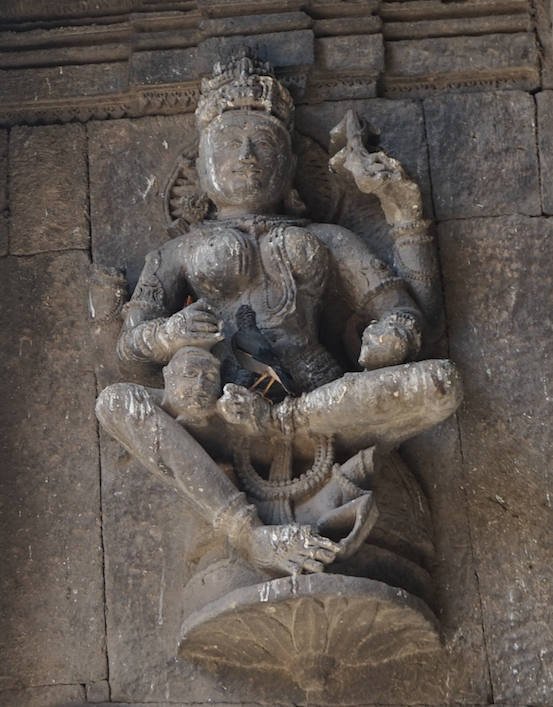
Scultura dal Mahudi Gate a Dabhoi nel Gujarat, risalenti al XIII secolo. Foto di James Mallinson e Daniela Bevilacqua.

First of all, we must consider that women who manage to become ascetics within the traditional orders are actually few and they often achieve that at an old age. But, I happened to meet a yogini who, at the age of 12, had completed her learning of the āsanas, ṣaṭkarma, etc. She does not describe her practices as haṭha yoga, she interprets them as steps of yoga, since she is also a practitioner of austerities and her idea of haṭha yoga is very related to tapasyā.

Then, I met another yogini who took the initiation as an adult, after raising her children. She is called Yogi by her order because she spent several years meditating in the jungle. But she also does body postures. In these years of fieldwork, I have met only two of them in the ascetic world as practitioners. Surely there are many more, but they often remain hidden.

If we consider the “secular” part of yoga in India, I have not seen different results. I have met some families in which yoga is practiced and transmitted in a traditional way into the family, but only to those who are considered worthy and able to complete entirely the training to allow further its transmission. Also, in this case, it is not taught to women (at least in northern India and according to my limited experience).

So yes, that yoga is now an extremely common practice among women is an innovative element compared to the past, at least as we can imagine looking at the present situation and considering the texts. The texts speak to us of the male practitioner, and many techniques focus on a male body. Surely there were yoginis in the past and even today there are, especially in tantric currents that do not call for the renunciation. However, a “haṭha yoga” tradition written by a woman has never been transmitted, although it is not uncommon to find miniatures representing women practitioners, especially of the Nāth order, while performing austerities.

Unfortunately, in many traditional contexts Indian society was, and still is, tough towards the individual development of a woman, both in the secular and religious fields.

Are you a yoga practitioner too, like other HYP members? If so, can you tell us about your relationship with this discipline?

The first time I practically approached yoga was in 2006 in Rishikesh: I started a course and followed classes twice a day, plus an evening meditation session. Back in Italy, I looked for teachers similar to that I had in Rishikesh, and I was deeply disappointed. I tried again with yoga in 2010 in Varanasi, with a fantastic teacher who did only one-on-one lessons. With him I resumed doing āsana and prāṇāyāma, but I never found a teacher who was able to go beyond them.

I must say that, although highly useful for the body and to create a state of relaxation, I sometimes found modern yoga classes boring or, when full of chitchat, quite irritating. So I started doing yogāsana as many sādhu do – not knowing that – that is, I make the positions I need when I need them and if I have time, to take care of my body a bit, especially when I’m in India. I try to put into practice, if necessary, the things that the ascetics tell me or show me. I can not say I practice yoga because seeing what yoga is for ascetics, having spent time with them, I realized I can not use such a word: I do not follow all the yama nor niyama, and I do not have the necessary faith to make it my spiritual discipline. So, with yoga I stay in a very friendly relationship: we know each other, but nothing more than I need to keep the body sthir (firm).

(Thanks to Daniela for helping us with the English translation)

Leggi

Archiviato in:Yoga Contrassegnato con: Daniela Bevilacqua, Hatha Yoga Project, hathayoga, James Mallinson, Mark Singleton

  • « Vai alla pagina precedente
  • Pagina 1
  • Pagine interim omesse …
  • Pagina 13
  • Pagina 14
  • Pagina 15
  • Pagina 16
  • Pagina 17
  • Pagine interim omesse …
  • Pagina 21
  • Vai alla pagina successiva »

Copyright © 2022 – Zénon Associazione Sportiva Dilettantistica via XXIII marzo 1849, 17 28100 Novara C. F. 94088150035 Privacy Policy. Termini e condizioni

Zénon Yoga Novara

Centro di yoga, meditazione, Qi Gong e Taijiquan. Corsi per ogni età e ogni livello.

info@zenon.it
Via Ventiré marzo 17 Novara, 28100
lunedì10:00 – 20:00
martedì, venerdì10:00 – 20:10
mercoledì10:00 – 20:40
giovedì10:00 – 19:00
sabato10:00 – 12:00
+393492462987

Contattaci su Whatsapp